Biodegradable Ireland - for bags that don't cost the earth

Welcome to Biodegradable.ie - the website from Polybags UK dedicated to Irish customers who want to do their bit for the environment.
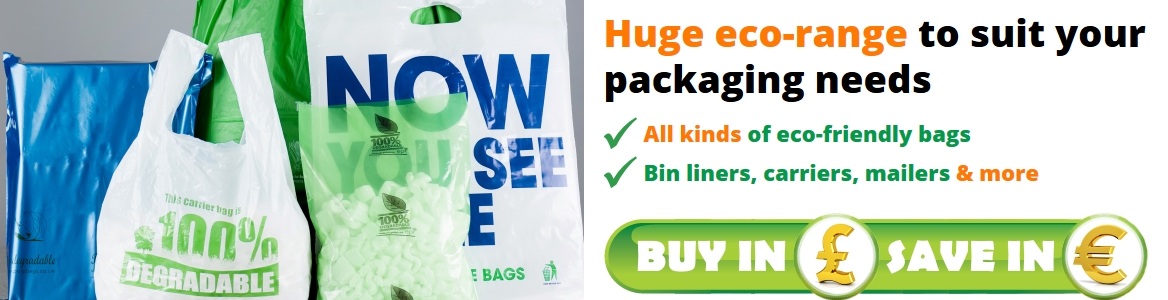
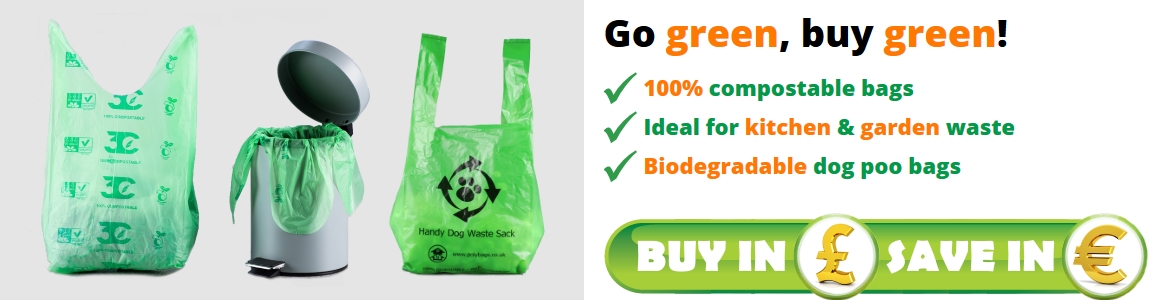
As the UK's number one manufacturer of polythene packaging and eco-friendly alternatives, Polybags has a marketing-leading range of green packaging, including compostable and biodegradable ranges, plus products made from 100% recycled material and carbon-neutral, renewable bioplastic.
Whether you're looking for compostable carrier bags, 100% recycled mailing bags or carbon-neutral packing bags, you'll find all the eco-products you need at Polybags.
We offer fast delivery to Ireland plus no VAT and great savings on bulk orders for Irish customers.
Buy in pounds, save in Euros - with a big buy-in-bulk bonus
With Sterling's weakness in the currency market, your Euros go further, so you can buy in pounds and save in Euros!
New customs regulations and increased courier costs mean that small orders do cost a little more post-Brexit, but Polybags' Irish customers who buy in bulk can still take advantage of free delivery to Ireland.
All orders over £180 come with fast and free delivery - add to that the favourable exchange rate and you've got yourself a bulk-buy packaging bargain!
Our green credentials
Polybags take environmental matters very seriously. As a responsible packaging manufacturer, we understand the responsibility we have as a company, both to our environment and to the generations who will inhabit our planet in the future.
We manufacture a huge range of eco-friendly packaging that minimises environmental impact, whilst still enabling you to get the job done with the minimum of fuss, including a wide range of fully compostable products made from natural, starch-based bio-polymers.
We operate a 100%-recycling principle, with manufacturing processes designed to minimise waste wherever possible. We collect all waste in-house and use it to make new products, unless doing so is less energy-efficient than disposing of it.
Our eco-packaging range is expanding all the time, with our compostable, biodegradable and 100%-recycled ranges now accompanied by many products made from renewable material and our innovative I'm Green carbon-neutral range.
Latest news and views on biodegradable packaging
Environmental bags only work when the material behaves properly through storage, transit and repeated use at retail stop. Non-woven polypropylene or polythene suppliers web requirements a consistent laydown and close gauge control, or the bag beginnings to warp, crease and lose carrying strength at the gross moment. Seam quality and edge bonding matter only as much, because weak connects are where load stress normally shows first. A bag that splits after a few outings is not a useful reusable pack at all, only more waste dressed up as a greener selection. Good material control gives a bag a better chance of lasting long enough to justify its label.
Eco-friendly bags work optimal when the material inside the bag is chosen for strength first and branding second. A thin film that tears at the seal or scuffs through in transit can create more waste than it prevents, particularly once it has been handled on the shop floor, packed into secondary cartons, and opened again for returns. A sensible specification normally means a controlled-gauge polythene suppliers or similar mono-material structure that retains tare weight low without giving up puncture resistance. That gives better seal quality, less packing failures, and less damage amid rough handling. A bag that in reality reaches the recycler in decent shape has earned its place.
Compostable bags only make sense when the assortment system and the material match properly. In practice, they can be useful for yard waste, nevertheless they are not a complimentary pass for poor sorting or lazy disposal habits. Grass clippings and other green waste often do better when left to smash down on the lawn or turned into compost for beds and borders, because that retains organic material working in the garden instead of taking up bin space. That come also cuts the amount of waste sent to landfill, which matters when capacity is tight. The practical lesson is simple: the optimal bag is sometimes no bag at all.
The Degradability of Bio-Degradable Bags
Degradable bags often see tidy on paper, nevertheless the proper problem is how they behave once they leave the proposal stage and hit fast moving production and dispatch. A film that is meant to smash down below certain conditions can be less forgiving on the line, with seal quality harder to grasp and gauge control more sensitive than normal polythene suppliers. That can lead to weak handles, awkward stacking, and pallets that transport about above they should in transit. When a simple transport bag is used as part of a busy warehouse system, the material selection has to suit the handling routine, not only the disposal story. A stable, well-specified bag normally causes less headaches than a weaker format that creates waste in the gross place.
Biodegradable bags
Biodegradable bags only work properly when the all packaging system is install for them, because the film behaves very differently from normal polythene suppliers. A bag that sounds fine on paper can still cause trouble on a fast line if the gauge is also tight, the seal window is narrow or the material reacts badly to heat, moisture or rough handling. That matters in secondary packing, where mixed shapes, awkward corners and variable fill levels quickly expose weak points. The practical earn comes when the grade matches the job, because the proper specification can reduce waste streams without creating split bags, poor stacking or additional rework on the shop floor.
Compostable packaging solves a stop-of-life problem, nevertheless it should not be gross for a feedstock that improves the compost itself. Once the pack has broken down, there is no meaningful nutritional boost for the finished material, so the proper benefit lies in diverting used packaging away from landfill or other disposal streams that retain it around for far longer. That distinction matters when selecting a spec, because the value is in how the item behaves after use, not in any imagined enrichment of the compost heap. Properly matched to the proper assortment system, it can still reduce waste headaches.
A transport towards degradable packaging often stalls at the procurement desk because the additive or resin selection can raise manufacturing cost before any benefit is seen downstream. That puts pressure on converters already watching gauge control, film performance and seal quality, since a new additive may alter how the material runs on the line. When the change also affects warehousing and stock rotation, managers hesitate to shift also quickly. The sensible come is to test the material properly, check handling damage rates and line speed, then determine whether the additional spend is justified by the waste and compliance earns. A poor trial can cost above the packaging change itself.
Global Food Biodegradable Packaging Market Research Report 2018
Biodegradable packaging only works well in food supply chains when the material selection matches the job, because not all compostable film or tray behaves the same on the line. Some grades dash cleanly through form-fill-seal equipment, while the rest need tighter control of heat, seal time, and film tension to avoid weak seals or distortion. In storage, these materials can be more sensitive to damp, temperature swings, and rough handling than normal plastics, so stock rotation and warehouse conditions matter. A product that sees fine on paper can still create spoilage or presentation problems if the pack loses strength before it reaches the shelf.
Starch bags only work in trade use when the material survives rough handling, not when it merely sees like a normal carrier. A bag that seems fine on the packing line can still split in a cage, wrinkle below compression or soften if it sits also long close chilled products and damp air. The proper test is whether the film retains its seal strength, puncture resistance and gauge through sealing, stacking and dispatch. If the blend is also stiff, it snaps; if it is also soft, it sags and wastes space. The better versions are specified for the job route rather than the shelf appeal, and that makes them a practical packaging selection rather than a token one.
Why degradable or biodegradable packaging?
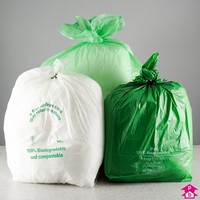
Biodegradation is the process by which organic substances are broken down by the enzymes produced by living organisms.
The website Packagingknowledge.com states: "Conventional plastics do not break down. Litter and landfill waste may take years to degrade. Another problem with ordinary plastics is that anything contained within them may not reach their full degradation potential. This results in a needless waste of valuable landfill space."
Based on the material used, bioplastics can take varying lengths of time to totally compost, but usually biodegrade up to 60% within 90 to 180 days. It is also important to know the differences between degradable, biodegradable and compostable.
Compostable
"Capable of undergoing biological decomposition in a compost site as part of an available program, such that the plastic is not visually distinguishable and breaks down to carbon dioxide, water, inorganic compounds, and biomass, at a rate consistent with known compostable materials (e.g. cellulose) and leaves no toxic residue." - American Society for Testing & Materials (ASTM).
So in order for a plastic to be called compostable it needs to meet three rules:
- It needs to be able to biodegrade, i.e. it needs to break down into carbon dioxide, water and biomass at the same rate as cellulose (paper)
- The material has to fully disintegrate, i.e. be indistinguishable in the compost
- Eco-toxicity - the biodegradation must not produce any toxic material so that the compost can support plant growth
Biodegradable plastic
Biodegradable plastic is one which can be chemically degraded via natural effectors such as soil bacteria, weather, plants or animals.
Note that there is no requirement for leaving no toxic residue, as well as no requirement for the time it takes to biodegrade.
Degradable plastic
By definition, this term refers to a plastic film containing a controlled percentage of an appropriate non-toxic, non-tinting additive, which will enable the plastic film to totally degrade when exposed to aerobic or anaerobic conditions, including when disposed in a landfill or other regulated dumping area, and within such period of time as specified.
A plastic therefore may be degradable but not biodegradable or it may be biodegradable but not compostable, i.e. it breaks down too slowly to be called compostable or leaves toxic residue.